7644fg.j-7doll: Understanding the Meaning, Use Cases, and Troubleshooting in Python
A Deep Dive into the Mysterious Identifier Confusing Developers Worldwide

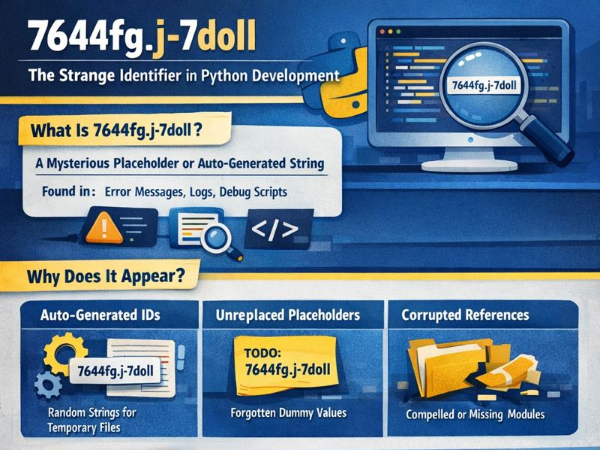
If you’ve encountered 7644fg.j-7doll in Python programming, it is not an official library, module, or documented error code. Instead, it typically appears as a random or autogenerated identifier, placeholder string, misconfigured reference, or artifact from debugging logs, scripts, or automated systems. Understanding 7644fg.j-7doll helps developers diagnose errors faster, clean up corrupted references, and improve overall code reliability, especially when dealing with large or dynamic Python projects.
What Is 7644fg.j-7doll?
The term 7644fg.j-7doll does not belong to Python’s standard library, nor is it a recognized third‑party package. Developers often encounter it unexpectedly—inside error messages, application logs, search histories, or misfiring scripts. Its unusual structure strongly suggests that it is not meant for direct human use, but rather generated by automated processes, test environments, or incomplete code paths.
In most real‑world scenarios, 7644fg.j-7doll acts as a symbolic marker rather than a functional element. It may represent a missing file, an invalid module name, a temporary identifier, or a placeholder that was never replaced during development.
Why Does 7644fg.j-7doll Appear in Python Projects?
Python projects—especially modern ones—often rely on automation, dynamic imports, background jobs, and third‑party tools. This complexity increases the chance of unusual identifiers surfacing. The appearance of 7644fg.j-7doll is usually the result of one of the following situations:
Autogenerated Identifiers
Some scripts and tools generate random strings to label sessions, cache files, or temporary objects. If these identifiers leak into logs or errors, they can confuse developers who expect meaningful names.
Placeholder Values Left Behind
During development, placeholders are frequently used to mark unfinished sections of code. If not replaced before deployment, they may surface as mysterious strings like 7644fg.j-7doll.
Corrupted or Misnamed Files
A single typo in a filename or module import can cause Python to reference something that doesn’t exist. When this happens, Python may echo the invalid name back in an error message.
Is 7644fg.j-7doll a Python Error Code?
No. Python does not define error codes in this format. Python errors are descriptive and human‑readable, such as ModuleNotFoundError, ImportError, or TypeError. When 7644fg.j-7doll appears alongside an error, it is almost always part of the context, not the error itself.
For example, it may be:
The name of a missing module
A malformed configuration value
A corrupted environment variable
Understanding this distinction is critical. Treating 7644fg.j-7doll as an error code will lead to wasted debugging time.
Common Scenarios Where Developers Encounter 7644fg.j-7doll
In Python Error Messages
A developer might see 7644fg.j-7doll mentioned when Python fails to locate a resource. This usually means the program attempted to load something that doesn’t exist or is incorrectly named.
In Application Logs
Logging systems often capture raw identifiers produced by background tasks. If a task fails mid‑execution, the identifier may appear without explanation.
In Search or Browser History
Some developers report seeing 7644fg.j-7doll appear in search histories without intentional input. This is usually unrelated to Python itself and may be caused by automated scripts, extensions, or cached data.
Is 7644fg.j-7doll Dangerous?
On its own, 7644fg.j-7doll is not dangerous. It is not malware, spyware, or a known exploit. However, its presence can sometimes point to deeper issues:
Misconfigured scripts
Broken dependencies
Unwanted browser extensions
Poor input validation
The identifier itself is harmless, but ignoring it may allow real problems to persist unnoticed.
How to Troubleshoot 7644fg.j-7doll in Python
Search Your Codebase
Scan your project for any reference to the string. It may exist in configuration files, environment variables, or commented‑out code.
Review Recent Changes
Identifiers like this often appear after refactoring, dependency updates, or automated code generation. Reviewing recent commits can quickly reveal the source.
Check Imports and File Names
Ensure that all imported modules and referenced files exist and are spelled correctly. Python is strict about naming consistency.
Clear Cache and Temporary Files
Stale cache files can cause Python to reference outdated or invalid objects. Clearing cached data often resolves unexplained behavior.
Best Practices to Prevent Issues Like 7644fg.j-7doll
Use Meaningful Identifiers
Avoid random strings for variables, files, or modules unless absolutely necessary. Clear naming improves maintainability and debugging speed.
Validate Configuration Inputs
Always validate configuration values loaded from external sources. Unexpected identifiers often enter systems through unchecked inputs.
Log with Context
Logging raw identifiers without explanation can confuse future developers. Include descriptive messages alongside identifiers.
Perform Regular Code Reviews
Fresh eyes catch leftover placeholders and malformed references that automated tests may miss.
Lessons for Python Developers
The mystery of 7644fg.j-7doll highlights an important truth about programming: not everything that appears in code has intrinsic meaning. Some identifiers exist purely as artifacts of development processes.
Experienced developers learn to distinguish between:
Legitimate language features
Third‑party tools
Accidental leftovers
Recognizing this difference saves time and reduces frustration.
Can 7644fg.j-7doll Ever Be Legitimate?
In private projects, yes. A developer could intentionally name a file, variable, or internal token using a custom alphanumeric identifier. In such cases, it has meaning only within that specific codebase. Outside of that limited context, however, it carries no standardized or widely accepted definition.
This is why public documentation and open repositories do not reference such identifiers as recognized Python concepts.
Why Developers Search for Unfamiliar Identifiers
The surge in searches for unusual strings reflects a broader pattern: developers often research unfamiliar identifiers they encounter unexpectedly in logs, errors, or system output. This curiosity is both healthy and necessary in a field where small details can signal larger problems.
By understanding that these identifiers are not official Python elements, developers can refocus their efforts on identifying the real source of the issue.
Final Thoughts on Mysterious Identifiers
These strings are not Python libraries, error codes, or hidden features. They are best understood as byproducts—identifiers that surface when something else goes wrong or remains unfinished.
For Python programmers, the real value lies not in memorizing obscure terms, but in learning how to:
Analyze unexpected identifiers
Trace their origins
Improve code hygiene and debugging habits
Mastering these skills will make you a stronger, more confident developer—regardless of what strange string appears next.