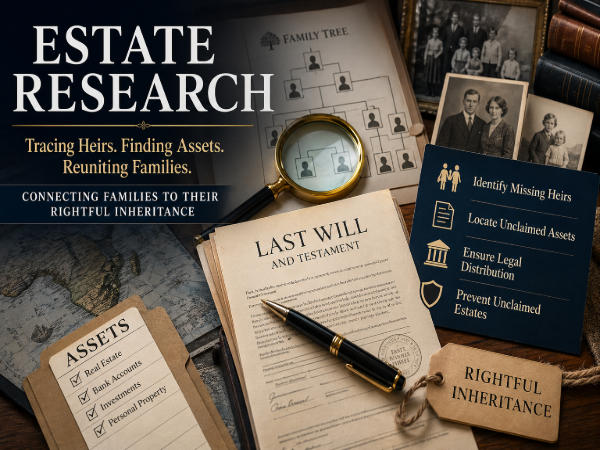
Estate research is the professional process of identifying missing heirs and locating unclaimed assets within a deceased person’s estate. Conducted by probate genealogists, it involves using historical records, legal documents, and genealogical techniques to trace rightful beneficiaries. This process ensures that estates are distributed according to legal requirements, prevents assets from remaining unclaimed, and helps families reconnect with their inheritance.
Table of Contents
ToggleIntroduction to Estate Research
Estate research plays a crucial role in modern legal and financial systems. When a person passes away, their estate—comprising property, money, and other assets—must be distributed according to a will or legal guidelines. However, not all cases are straightforward. Sometimes heirs are unknown, missing, or difficult to locate. In other cases, assets may remain undiscovered or unclaimed.
This is where estate research becomes essential. It bridges the gap between legal processes and family history, ensuring that no rightful heir is overlooked and no asset is left behind. By combining investigative skills with genealogical expertise, estate research professionals help bring clarity and closure to complex inheritance cases.
What Is Estate Research?
Estate research is a specialized service focused on investigating deceased estates to identify beneficiaries and uncover assets. It is often carried out in situations where there is no clear will, incomplete family information, or disputes over inheritance.
The process involves detailed analysis of historical records, family trees, and legal documents. Estate researchers work closely with solicitors, courts, and financial institutions to ensure that all aspects of the estate are accounted for and distributed properly.
At its core, estate research is about answering two critical questions:
- Who is entitled to inherit?
- What assets are part of the estate?
The Role of Probate Genealogists
Probate genealogists, often referred to as heir hunters, are professionals who specialize in estate research. Their primary task is to trace and verify heirs, even when connections are distant or unclear.
These experts use a variety of resources, including:
- Birth, marriage, and death records
- Census data
- Immigration and military records
- Historical archives and registries
Their work requires both analytical thinking and persistence. In many cases, they must track family lines across generations and geographic boundaries to locate rightful beneficiaries.
Why Estate Research Is Important
Estate research serves multiple purposes, all of which are vital to the proper functioning of inheritance systems.
Ensuring Legal Compliance
When someone dies, their estate must be distributed according to the law. Estate research ensures that this process is carried out correctly by identifying all eligible heirs.
Preventing Unclaimed Assets
Without proper investigation, assets may remain unclaimed or revert to the state. Estate research helps recover these assets and return them to rightful owners.
Supporting Families
For many families, estate research provides closure and financial support. It reconnects relatives who may not have been aware of their inheritance.
Assisting Legal Professionals
Lawyers and executors rely on accurate information to manage estates. Estate research provides the evidence needed to resolve complex cases.
Key Components of Estate Research
Estate research is a multi-step process that involves several important components.
Heir Identification
This is the most critical aspect of estate research. It involves locating and confirming individuals who are legally entitled to inherit from the estate.
Genealogical Investigation
Researchers build detailed family trees to establish relationships between the deceased and potential heirs. This requires careful examination of historical records.
Asset Discovery
Identifying all assets within an estate is equally important. This may include real estate, bank accounts, investments, and personal belongings.
Verification and Documentation
All findings must be supported by official documents. This ensures that claims are legitimate and legally valid.
How the Estate Research Process Works
The estate research process typically follows a structured approach.
Case Assessment
The process begins with an initial review of the estate. Researchers gather available information and determine the scope of the investigation.
Data Collection
Relevant records and documents are collected from various sources. This may include public archives, legal records, and financial statements.
Family Tree Construction
A detailed family tree is created to map out relationships and identify potential heirs.
Heir Tracing
Researchers locate and contact individuals who may be entitled to inherit. This often involves extensive searches and verification.
Legal Verification
All findings are reviewed and confirmed through legal documentation to ensure accuracy.
Reporting
A comprehensive report is prepared and submitted to the relevant parties, such as lawyers or executors.
Challenges in Estate Research
Estate research is not without its difficulties. Professionals in this field often face complex challenges.
Missing Records
In some cases, records may be incomplete or unavailable, making it difficult to trace family connections.
International Cases
When heirs are located in different countries, researchers must navigate varying legal systems and languages.
Common Names
Individuals with common names can be difficult to identify accurately, requiring additional verification.
Disputes Among Heirs
Conflicts between potential beneficiaries can complicate the process and require careful handling.
Tools and Techniques Used in Estate Research
Estate researchers rely on a wide range of tools and techniques to carry out their work effectively.
Public Records
Government databases and registries provide essential information about births, deaths, and marriages.
Digital Archives
Online platforms have made it easier to access historical records and trace family histories.
DNA Testing
In some cases, genetic testing is used to confirm relationships between individuals.
Field Research
Researchers may visit locations, interview individuals, and gather information directly from communities.
Legal Framework of Estate Research
Estate research operates within a strict legal framework. Laws governing inheritance vary by country, but the principles remain consistent.
Intestacy Laws
When a person dies without a will, intestacy laws determine how their estate is distributed. Estate research helps identify heirs according to these laws.
Probate Process
Probate is the legal process of administering an estate. Estate research supports this process by providing accurate information about heirs and assets.
Documentation Requirements
All claims must be supported by official documents to ensure legal validity.
Ethical Considerations in Estate Research
Ethics play a significant role in estate research. Professionals must adhere to high standards of integrity and transparency.
Accuracy
Providing accurate information is essential to maintaining trust and ensuring fair distribution.
Confidentiality
Sensitive personal information must be handled with care and discretion.
Fair Practices
Researchers must avoid conflicts of interest and act in the best interests of all parties involved.
Estate Research and Modern Technology
Technology has transformed the field of estate research in recent years.
Improved Access to Data
Digital databases have made it easier to access records from around the world.
Faster Communication
Researchers can quickly connect with potential heirs using modern communication tools.
Advanced Analysis
Software tools allow for more efficient analysis of large amounts of data.
Despite these advancements, human expertise remains essential. Technology can assist, but it cannot replace the judgment and experience of skilled researchers.
Real-World Applications of Estate Research
Estate research is used in a variety of real-world situations.
Unclaimed Estates
When no heirs are immediately identified, researchers step in to locate beneficiaries.
Complex Family Structures
Blended families, adoptions, and multiple marriages can create complicated inheritance scenarios.
Historical Cases
Some estates remain unresolved for years or even decades. Estate research helps bring these cases to a conclusion.
Benefits of Estate Research
Estate research offers numerous benefits to individuals and organizations.
For Families
- Provides access to rightful inheritance
- Reconnects family members
- Offers financial support
For Legal Professionals
- Simplifies complex cases
- Ensures compliance with laws
- Reduces risk of disputes
For Governments
- Prevents assets from remaining unclaimed
- Ensures proper management of estates
Future of Estate Research
The future of estate research looks promising, with continued advancements in technology and data accessibility.
Greater Global Reach
Researchers will be able to trace heirs across borders more efficiently.
Enhanced Accuracy
Improved tools and techniques will lead to more precise results.
Increased Demand
As populations grow and family structures become more complex, the need for estate research will continue to rise.
Conclusion
Estate research is a vital process that ensures fairness, accuracy, and legal compliance in the distribution of wealth after death. By identifying heirs and locating assets, it prevents estates from remaining unclaimed and helps families receive what they are rightfully entitled to.
Through a combination of genealogical expertise, legal knowledge, and investigative skills, estate research professionals play an essential role in modern society. Their work not only supports legal systems but also brings closure and opportunity to families around the world.
In an increasingly complex world, estate research remains a powerful tool for connecting the past with the present, ensuring that no inheritance is lost and no rightful heir is forgotten.