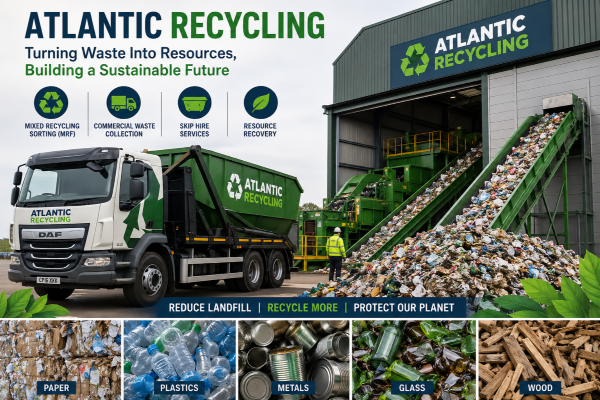
Atlantic Recycling is a waste management and recycling company specializing in mixed recycling sorting, skip hire, commercial waste collection, and resource recovery services. Using advanced Material Recovery Facility (MRF) systems, the company separates recyclable materials such as plastics, paper, metals, and glass from mixed waste streams to reduce landfill dependency and promote environmental sustainability. Atlantic Recycling plays an important role in supporting the circular economy by converting waste into reusable resources through innovative recycling processes and efficient waste management solutions.
Table of Contents
ToggleIntroduction to Atlantic Recycling
Waste management has become one of the most important environmental challenges in the modern world. As urban populations continue to grow and industries produce increasing amounts of waste, companies that specialize in recycling and sustainable waste processing are becoming essential to environmental protection. Among the organizations working in this sector, Atlantic Recycling has established itself as a significant player in waste management and recycling operations.
Atlantic Recycling is recognized for offering a wide range of waste handling services designed to improve recycling efficiency and reduce landfill waste. The company focuses on collecting, sorting, processing, and recovering valuable recyclable materials from mixed waste streams. Through advanced recycling systems and environmentally responsible operations, Atlantic Recycling supports sustainability goals while helping businesses and communities manage waste more effectively.
The company’s operations include skip hire services, commercial waste collection, recycling processing, resource recovery, and waste transfer solutions. By investing in modern recycling technologies and Material Recovery Facilities, Atlantic Recycling has contributed to the development of more efficient waste management systems capable of handling large volumes of recyclable materials.
As environmental concerns continue to influence industries worldwide, recycling companies like Atlantic Recycling are becoming increasingly important in supporting greener economies and sustainable resource management.
Understanding the Role of Atlantic Recycling in Waste Management
Waste management involves more than simply collecting rubbish and transporting it to landfill sites. Modern waste management focuses on reducing environmental impact by recovering recyclable materials and reusing resources whenever possible. Atlantic Recycling operates within this modern framework by prioritizing recycling, recovery, and sustainable disposal methods.
The company works with both domestic and commercial customers, helping them dispose of waste responsibly while minimizing environmental harm. Instead of allowing mixed waste to end up in landfills, Atlantic Recycling processes materials to separate recyclable items from non-recyclable waste.
This approach supports environmental sustainability because it helps reduce pollution, conserves natural resources, and decreases the need for raw material extraction. Recycling also lowers greenhouse gas emissions by reducing the amount of waste sent to landfill facilities.
Atlantic Recycling’s services are designed to improve waste handling efficiency across multiple sectors. Construction companies, businesses, households, and industrial operations all produce significant amounts of waste, and the company provides tailored solutions to manage those waste streams effectively.
What Is a Material Recovery Facility (MRF)?
One of the most important aspects of Atlantic Recycling’s operations is its Material Recovery Facility, commonly known as an MRF. A Material Recovery Facility is a specialized plant where mixed recyclable waste is sorted and separated into individual material categories.
At an MRF, waste passes through various stages of processing using advanced machinery and manual sorting systems. The goal is to recover valuable recyclable materials that can be reused in manufacturing and production processes.
Atlantic Recycling uses these facilities to process different types of recyclable materials, including:
- Paper and cardboard
- Plastics
- Glass
- Metals
- Wood
- Electronic waste
- Construction waste materials
The sorting process often includes conveyor systems, magnets, air separators, optical scanners, and manual quality control procedures. These technologies help maximize recovery rates while reducing contamination in recyclable materials.
By operating an efficient MRF system, Atlantic Recycling can significantly reduce the amount of waste sent to landfills while improving recycling performance across its service areas.
Skip Hire Services Offered by Atlantic Recycling
Skip hire is another important part of Atlantic Recycling’s business operations. Skip hire services provide customers with large containers used for collecting and transporting waste materials from homes, construction sites, offices, and industrial locations.
Different skip sizes are available depending on the type and volume of waste being generated. Customers can use skips for:
- Home renovation projects
- Garden clearance
- Construction waste disposal
- Commercial waste collection
- Industrial clean-up projects
Once the skips are collected, the waste is transported to recycling facilities where recyclable materials are separated and processed. This system helps reduce illegal dumping while encouraging responsible waste disposal practices.
Skip hire services are especially valuable for construction and demolition projects, where large quantities of waste materials must be managed safely and efficiently.
Commercial Waste Collection and Business Solutions
Businesses generate large volumes of waste every day, making commercial waste collection an essential service. Atlantic Recycling works with companies from various industries to provide reliable waste collection and recycling solutions.
Commercial waste collection services help businesses comply with environmental regulations while improving sustainability practices. Waste generated by offices, retail stores, restaurants, factories, and construction companies can often contain recyclable materials that should not be sent directly to landfill sites.
Atlantic Recycling offers structured waste collection systems designed to improve recycling rates and reduce disposal costs. Businesses can separate recyclable materials into dedicated waste streams, allowing the company to process those materials more effectively.
This approach benefits companies by improving environmental performance while also supporting corporate sustainability goals. Many organizations today prioritize environmentally responsible waste management as part of their brand reputation and long-term operational strategies.
The Importance of Resource Recovery
Resource recovery is a major concept in modern recycling and waste management. Instead of viewing waste as useless material, resource recovery focuses on extracting valuable components that can be reused or repurposed.
Atlantic Recycling plays an important role in this process by recovering recyclable resources from mixed waste streams. Materials such as metals, plastics, paper, and glass can be processed and transformed into raw materials for manufacturing industries.
This process reduces dependence on virgin resources and helps conserve natural materials. For example:
- Recycled paper reduces the need for tree harvesting
- Recycled metals reduce mining activities
- Recycled plastics reduce petroleum consumption
- Recycled glass reduces energy use in production
Resource recovery also supports economic sustainability by creating employment opportunities in recycling industries and reducing waste disposal costs for businesses and local authorities.
Environmental Benefits of Recycling
The environmental impact of recycling is one of the key reasons companies like Atlantic Recycling are so important. Recycling offers several environmental benefits that contribute to long-term sustainability.
One major benefit is landfill reduction. Landfills occupy large areas of land and can produce harmful greenhouse gases such as methane. By diverting recyclable materials away from landfill sites, recycling companies help reduce environmental pollution.
Another important benefit is energy conservation. Manufacturing products from recycled materials often requires less energy compared to producing products from raw materials. This helps reduce carbon emissions and supports climate change mitigation efforts.
Recycling also protects ecosystems by reducing the extraction of natural resources. Mining, logging, and oil extraction can cause habitat destruction, water pollution, and biodiversity loss. Recycling helps minimize these environmental impacts.
Atlantic Recycling contributes to these environmental improvements by processing large volumes of recyclable waste and supporting more sustainable waste management systems.
Advanced Recycling Technology and Innovation
Technology has transformed the recycling industry over the past several decades. Modern recycling facilities now use advanced equipment to improve sorting accuracy and material recovery efficiency.
Atlantic Recycling utilizes modern recycling systems to process mixed waste streams more effectively. These technologies may include:
- Optical sorting systems
- Magnetic separators
- Air classification equipment
- Conveyor belt systems
- Screening machinery
- Automated sorting technologies
Optical sorting machines use sensors and cameras to identify different types of materials based on color, shape, and composition. Magnets help separate ferrous metals, while air systems can distinguish lightweight materials from heavier objects.
Automation improves efficiency while reducing contamination levels in recyclable materials. High-quality recyclable materials are more valuable in manufacturing markets and easier to reuse in production processes.
Technological innovation continues to shape the future of waste management, allowing recycling companies to recover more materials while improving operational performance.
The Circular Economy and Sustainable Waste Management
Atlantic Recycling’s operations align closely with the principles of the circular economy. A circular economy is an economic system focused on reducing waste and maximizing the reuse of materials and resources.
Traditional economic systems often follow a linear model where products are manufactured, used, and discarded. In contrast, the circular economy encourages recycling, repairing, reusing, and recovering materials to keep resources in circulation for as long as possible.
Recycling companies are essential to this model because they help recover materials that would otherwise become waste. Atlantic Recycling supports the circular economy by turning discarded materials into reusable resources that can re-enter manufacturing supply chains.
This approach benefits both the environment and the economy. It reduces waste disposal costs, conserves natural resources, lowers emissions, and creates new business opportunities within recycling industries.
Construction and Demolition Waste Recycling
Construction and demolition projects generate large quantities of waste materials, including concrete, wood, metal, bricks, plastics, and soil. Without proper recycling systems, these materials can quickly overwhelm landfill facilities.
Atlantic Recycling provides waste management services for construction projects by collecting and processing construction waste materials. Many of these materials can be recycled and reused in future building projects.
For example:
- Crushed concrete can be reused as aggregate
- Recycled metal can be used in manufacturing
- Wood waste can be converted into biomass fuel
- Soil and rubble can be repurposed for landscaping and construction
Construction waste recycling supports sustainable building practices while reducing environmental impact within the construction industry.
Waste-to-Energy and Alternative Fuel Solutions
Not all waste materials can be recycled into new products. However, some non-recyclable waste can still be used for energy recovery. Atlantic Recycling supports waste-to-energy processes by converting residual waste into alternative fuels.
Refuse Derived Fuel (RDF) is one example of this process. RDF is created from combustible waste materials that cannot be easily recycled. These fuels can be used in industrial energy production and manufacturing operations.
Waste-to-energy solutions help reduce landfill dependency while generating usable energy from waste materials. Although recycling remains the preferred option, energy recovery provides an alternative solution for handling residual waste responsibly.
Challenges Facing the Recycling Industry
Despite the benefits of recycling, the industry faces several ongoing challenges. Contamination in recyclable waste streams remains one of the biggest issues. When non-recyclable materials are mixed with recyclable waste, sorting becomes more difficult and processing costs increase.
Market fluctuations also affect the recycling sector. The value of recyclable materials can change based on global demand, manufacturing trends, and economic conditions.
Another challenge is public awareness. Many people still lack understanding about proper recycling practices, leading to incorrect waste disposal behaviors.
Companies like Atlantic Recycling must continuously invest in technology, education, and operational improvements to overcome these challenges and maintain effective recycling systems.
The Future of Atlantic Recycling and Sustainable Waste Solutions
The future of waste management will likely focus heavily on sustainability, technological innovation, and environmental responsibility. Recycling companies are expected to play an even larger role as governments and industries adopt stricter environmental policies.
Atlantic Recycling is positioned within a growing industry that continues to expand due to rising environmental awareness and increasing demand for sustainable waste solutions.
Future developments may include:
- Greater automation in recycling facilities
- Improved waste sorting technologies
- Increased recycling efficiency
- Expansion of circular economy initiatives
- Stronger environmental regulations
- Higher demand for recycled materials
As recycling systems continue to evolve, companies specializing in resource recovery and waste processing will remain essential to environmental sustainability efforts.
Conclusion
Atlantic Recycling has established itself as an important company within the waste management and recycling sector by focusing on sustainable waste processing, recycling efficiency, and resource recovery. Through services such as skip hire, commercial waste collection, Material Recovery Facility operations, and recycling processing, the company helps reduce landfill waste while promoting environmental sustainability.
By separating recyclable materials from mixed waste streams and converting waste into reusable resources, Atlantic Recycling supports the principles of the circular economy and contributes to long-term environmental protection. The company’s investment in recycling technology and sustainable waste management practices reflects the growing importance of responsible resource handling in today’s world.
As environmental concerns continue to shape industries and communities worldwide, recycling companies like Atlantic Recycling will remain vital in helping societies manage waste more sustainably, conserve natural resources, and reduce environmental impact for future generations.