Tech Giants Envision Future Beyond Smartphones: The Next Era of Digital Interaction
From handheld devices to immersive experiences, tech leaders are redefining the way we interact with technology through AI, augmented reality, and wearable computing.

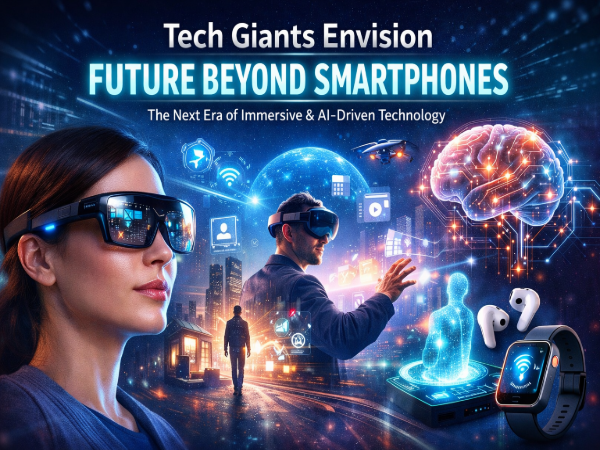
Smartphones have been the cornerstone of modern digital life for over a decade, connecting us to work, entertainment, social networks, and commerce. However, tech giants envision a future beyond smartphones, where technology transcends handheld screens and becomes intelligent, wearable, and seamlessly integrated into our environment. Through innovations in augmented reality, artificial intelligence, spatial computing, and ambient devices, the next generation of digital interaction promises to be immersive, context-aware, and intuitive, fundamentally transforming how humans communicate, work, and live.
Introduction: The Smartphone Era Is Reaching Its Limits
Over the past decade, smartphones have transformed from simple communication tools into multifunctional hubs for nearly every aspect of daily life. They serve as our wallets, cameras, social platforms, productivity centers, and entertainment systems. Despite their revolutionary impact, smartphones are beginning to reach physical and functional limits. Rectangular screens, touch-based interfaces, and reliance on manual interaction cannot fully satisfy the growing demand for hands-free, immersive, and intelligent experiences.
Recognizing this, major tech companies are envisioning a future beyond smartphones — one where technology is immersive, context-aware, and integrated into the physical world. This transition marks the beginning of a new era in personal computing, where devices anticipate our needs, interact seamlessly with the environment, and augment human capabilities rather than simply serve as tools.
Why the Shift Beyond Smartphones Is Inevitable
Several factors are driving the move away from traditional smartphones:
Physical and Design Limitations
Smartphones, by their very nature, are confined to rectangular touchscreens. The limitations in screen size, battery life, and portability restrict their ability to deliver fully immersive experiences.
Increasing Demand for Immersive Experiences
Users increasingly crave hands-free, visually rich, and spatially aware technology. Applications like virtual meetings, 3D gaming, real-time translation, and contextual AI cannot be fully realized through a handheld device alone.
Rise of Artificial Intelligence
AI is no longer confined to apps or cloud services; it is becoming a proactive assistant embedded directly into devices, capable of predicting user behavior, automating tasks, and providing context-specific information instantly.
Ambient Computing and Wearables
The growing ecosystem of wearable devices — smart glasses, earbuds, watches, and sensors — creates opportunities for seamless interaction, where technology operates quietly in the background rather than demanding constant attention.
How Tech Giants Are Pioneering the Post-Smartphone Era
Several major technology companies are actively shaping this next generation of computing:
Apple: Spatial Computing and AI Integration
Apple has invested heavily in augmented reality and AI-powered devices. Through platforms like Vision Pro and upcoming AR glasses, Apple envisions a world where digital content overlays the physical environment, offering new ways to communicate, learn, and work. These devices aim to provide intuitive, context-aware interactions that go beyond tapping on a screen.
Google: AI Glasses and Android XR
Google is developing AI-powered wearable devices and AR platforms under its Android XR initiative. By integrating voice control, spatial computing, and AI assistants, Google aims to deliver immersive experiences that replace smartphones as the primary interface for digital life.
Meta: Mixed Reality and the Metaverse
Meta is aggressively pursuing mixed reality devices and smart glasses, building a vision where digital and physical worlds coexist. These devices are designed to enable social connection, collaboration, and entertainment in ways that smartphones cannot, positioning Meta as a leader in hands-free computing.
Microsoft: Enterprise Mixed Reality
Microsoft focuses on HoloLens and enterprise-focused mixed reality solutions, leveraging spatial computing to transform training, collaboration, and remote work. By creating devices that integrate digital information directly into the user’s environment, Microsoft is redefining how businesses interact with technology.
Samsung: XR and Wearable Innovation
Samsung is expanding its Galaxy XR line of devices, combining AR, VR, and AI into immersive platforms. By targeting both consumer and enterprise markets, Samsung is positioning itself to lead in the next generation of personal computing hardware.
Key Technologies Driving the Post-Smartphone Future
Augmented and Mixed Reality (AR/MR)
AR and MR allow digital content to interact with the physical world. From immersive gaming and education to professional design and navigation, spatial computing redefines how humans perceive and interact with digital information.
Artificial Intelligence (AI)
AI transforms devices from passive tools into intelligent assistants capable of anticipating user needs, automating repetitive tasks, and delivering real-time insights. In a post-smartphone world, AI is central to creating context-aware experiences that are both personal and adaptive.
Wearable Devices
Wearables are replacing the need to carry smartphones constantly. Smart glasses, earbuds, watches, and body sensors create an ecosystem of interconnected devices that deliver notifications, information, and interactions seamlessly.
Ambient Computing
Ambient computing embeds technology into everyday objects and environments. From smart homes to office spaces, sensors and AI interact quietly with users, offering information and assistance without demanding explicit attention.
Brain-Computer Interfaces (Future Prospects)
Though still emerging, brain-computer interfaces promise thought-controlled digital interactions, potentially replacing touch and voice entirely in the decades to come.
Implications for Society and Daily Life
The shift beyond smartphones will affect nearly every aspect of human life:
Communication: Hands-free devices will enable more natural interaction and collaboration.
Work and Productivity: Spatial computing will enhance virtual meetings, training, and project visualization.
Entertainment: Immersive gaming, 3D storytelling, and AR experiences will become mainstream.
Healthcare: Wearables and ambient sensors can monitor health in real time and provide AI-assisted interventions.
Commerce: Personalized, context-aware recommendations and purchases will integrate seamlessly into daily life.
Challenges on the Path Beyond Smartphones
While the potential is enormous, several challenges remain:
Privacy and Security: As devices collect more personal data, protecting user privacy will be critical.
Cost and Accessibility: Early-generation AR glasses, AI wearables, and mixed reality devices may remain expensive for mainstream adoption.
User Adaptation: Transitioning from smartphones to immersive devices requires cultural and behavioral shifts.
Technical Limitations: Battery life, computational power, and network infrastructure must improve to support real-time, immersive experiences.
The Timeline: What to Expect in the Next Decade
Experts predict a gradual transition:
Late 2020s: Early adopters embrace AR glasses, AI wearables, and enterprise mixed reality.
Early 2030s: Mainstream adoption begins as devices become lighter, more affordable, and more powerful.
Mid-2030s and Beyond: Smartphones may no longer be the central hub, replaced by ecosystems of wearable and ambient devices integrated with AI and spatial computing.
Conclusion: A Seamless Future Awaits
Tech giants envision a future beyond smartphones — a world where digital interactions are immersive, intelligent, and seamlessly integrated into our surroundings. The combination of AR, AI, wearables, spatial computing, and ambient devices promises to redefine human-computer interaction, moving us from tapping on screens to experiencing technology as a natural extension of our lives. While challenges remain, the post-smartphone era is on the horizon, promising a digital ecosystem that is smarter, more intuitive, and profoundly transformative.