Partners G15Tool: The Future of Digital Collaboration and Intelligent Partnership Ecosystems
How a modern collaboration framework is reshaping teamwork, innovation, and digital growth across industries

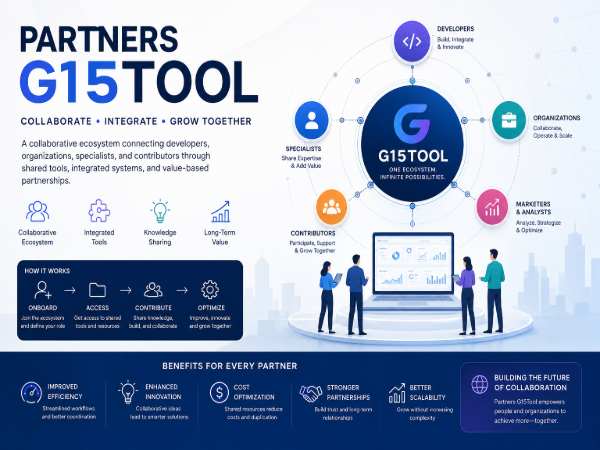
Partners G15Tool is a collaborative ecosystem designed to connect developers, organizations, specialists, and contributors within a unified digital framework. It focuses on improving cooperation through shared tools, integrated systems, and value-based partnerships. Instead of traditional referral programs, it emphasizes long-term collaboration, operational efficiency, and knowledge sharing. This model allows participants to work together more effectively, streamline workflows, and achieve mutual growth in competitive digital environments.
Table of Contents
ToggleIntroduction to Partners G15Tool
In today’s rapidly evolving digital world, collaboration is no longer limited to simple communication or basic teamwork. Businesses and individuals now require integrated systems that allow seamless interaction, shared tools, and continuous innovation. This is where Partners G15Tool emerges as a modern concept of structured digital collaboration.
Unlike traditional partnership or affiliate models, this ecosystem focuses on building long-term operational relationships rather than short-term gains. It connects different types of professionals—developers, marketers, analysts, creators, and organizations—into one coordinated environment where each participant contributes value and benefits from collective progress.
The idea behind Partners G15Tool reflects the growing demand for smarter digital ecosystems where tools, expertise, and services are unified into a single collaborative structure.
Understanding the Concept of Partners G15Tool
At its core, Partners G15Tool represents a network-based collaboration system. Instead of working in isolation, participants become part of a shared environment where resources and knowledge are distributed efficiently.
This system is built on three key principles:
Integration of Tools and Services
Participants can access shared tools and digital resources that improve productivity and reduce operational gaps.
Collaborative Knowledge Sharing
Experts from different fields contribute insights, strategies, and solutions that help improve overall performance.
Value-Based Cooperation
Rather than focusing only on transactions, the system promotes long-term value creation between all involved parties.
This structure transforms how digital partnerships operate by shifting from competition-driven models to cooperation-driven ecosystems.
How Partners G15Tool Works in Practice
The operational model of Partners G15Tool is designed to support smooth interaction between multiple participants. It typically functions through a connected workflow system.
Onboarding of Partners
Organizations or individuals join the ecosystem and define their role based on expertise or business goals.
Access to Shared Environment
Once onboarded, partners gain access to tools, dashboards, and communication channels that support collaboration.
Contribution and Interaction
Each participant contributes by sharing knowledge, building tools, or offering services that enhance the ecosystem.
Continuous Optimization
The system evolves through feedback, updates, and improved coordination between partners.
This continuous cycle ensures that all participants remain active contributors while benefiting from collective improvement.
Key Features of Partners G15Tool
The strength of this ecosystem lies in its unique features that distinguish it from traditional partnership programs.
Unified Digital Workspace
All participants operate within a centralized system that improves coordination and reduces fragmentation.
Multi-Role Participation
Developers, marketers, analysts, and businesses can all participate in different capacities.
Scalable Collaboration Model
The system can grow with increasing users without losing efficiency or structure.
Data-Driven Decision Support
Insights and analytics help partners make informed decisions.
Cross-Functional Integration
Different teams and tools work together seamlessly within one environment.
These features make the system adaptable to various industries and business needs.
Benefits of Partners G15Tool for Organizations
Organizations adopting a model like Partners G15Tool can experience several advantages:
Improved Efficiency
Centralized tools and communication reduce delays and improve workflow management.
Enhanced Innovation
Collaboration between different experts encourages creative problem-solving.
Cost Optimization
Shared resources reduce the need for separate tools and platforms.
Stronger Partnerships
Long-term cooperation builds trust and stability between organizations.
Better Scalability
Businesses can expand operations without significantly increasing complexity.
These benefits are particularly valuable in industries where digital transformation is a priority.
Benefits for Developers and Contributors
Not only organizations but also individual contributors gain value from this ecosystem.
Skill Development
Working in a collaborative environment helps developers improve technical and strategic skills.
Exposure to Real Projects
Participants can engage in meaningful work that has real-world impact.
Networking Opportunities
The system connects professionals across industries and regions.
Continuous Learning
Access to shared knowledge resources encourages ongoing learning.
This makes Partners G15Tool attractive for professionals looking to grow in their careers.
Role of Collaboration in the Digital Ecosystem
Modern digital systems rely heavily on collaboration. No single organization can handle all aspects of development, marketing, analytics, and operations alone.
Partners G15Tool reflects this reality by creating a cooperative ecosystem where specialization is encouraged. Instead of duplicating efforts, participants focus on what they do best while relying on others for complementary tasks.
This reduces inefficiencies and leads to more structured and effective outcomes.
Challenges in Implementing Such Systems
While the concept is powerful, it also comes with challenges:
Coordination Complexity
Managing multiple participants requires strong systems and governance.
Communication Barriers
Ensuring clear communication between diverse teams can be difficult.
Consistency in Contribution
Not all participants may contribute equally, which can affect balance.
Scalability Issues
As the network grows, maintaining performance and structure becomes more challenging.
Addressing these challenges requires strong digital infrastructure and clear operational rules.
Future of Partners G15Tool and Similar Ecosystems
The future of digital collaboration is moving toward fully integrated ecosystems where tools, people, and processes operate in harmony.
Systems like Partners G15Tool represent an early model of this evolution. As technology advances, we can expect:
- More automation in collaboration workflows
- Smarter AI-driven coordination systems
- Deeper integration between tools and platforms
- Global expansion of partnership ecosystems
- Increased focus on value-driven collaboration
This direction suggests that traditional isolated working models will gradually be replaced by interconnected systems.
Why Partners G15Tool Matters in the Modern Digital Age
The importance of such ecosystems lies in their ability to solve modern challenges:
- Information overload
- Fragmented workflows
- Lack of coordination
- Inefficient communication
By addressing these issues, Partners G15Tool introduces a more organized and scalable way of working that aligns with modern digital demands.
Conclusion
Partners G15Tool represents a modern approach to digital collaboration that focuses on integration, shared value, and long-term cooperation. Instead of functioning as a simple referral system, it builds a structured ecosystem where developers, organizations, and contributors work together toward common goals.
While still evolving in definition and implementation, its core idea reflects the future of work—one that is interconnected, efficient, and driven by collaboration rather than isolation.